
ADOPT A RESCUE RABBIT
Penny & Wild: Smalls of South Florida is a 501(c)(3) non-profit, no-kill sanctuary and rescue dedicated to providing a safe haven for special-needs rabbits & guinea pigs located in South Florida. We currently have 3 special-needs guinea pigs & 7 special-needs rabbits in our care:
We also have rabbits & guinea pigs who do not have special needs who are looking for loving, foster and forever homes. By adopting from a small-animal rescue, you are not only saving a life but also making room for us to rescue another in need so THANK YOU!!
Wondering where to get a rabbit or guinea pig? Here’s why you should adopt from a small-animal rescue:
Unlike most rabbits & guinea pigs that come from Petstores, farms or breeders, all of our rabbits & guinea pigs are spay / neutered prior to adoption and get annual wellness exams to ensure they are healthy.
Adoption Fee: $100 / rabbit

Are you thinking about adopting a rabbit? Did you know …
- 3rd most popular & 3rd most abandoned pet in the US.
- 10+ year commitment.
- 3-4 hrs of attention and care per day.
- $2,500+ per year in food, supplies and care.
- 4 ft × 4 ft (16 sq ft) living space per rabbit – no cages or hutches.
- $$$ Need to be seen by an Exotic Vet every year; a wellness exam costs $75-90 in FL.
Our adoption process is designed to ensure every home is set up for furever success and is well-prepared for their new pet. The approval timeline can vary depending on how quickly applicants complete the 3 steps below.
Typically, it takes 1-2 weeks from the start of the process until you can welcome your new rabbit(s) into your home.
1. APPLICATION
- Submit an Adoption Application
- Zoom Adoption Orientation / Bunny101
- Complete POST Bunny101 Questionnaire
2. PREPARATION
- Schedule a Meet & Greet
- Order Required Supplies
- Submit picture Home Set-up
- Bunny Proof your home
3. ADOPTION
- Schedule Home Visit / Drop-off
- Complete Foster-to-Adopt trial
- Pay Adoption Fee: $100 / rabbit
TO APPLY:
- Must be 18 years of age or older and provide a driver licence or state ID.
- If under 21 and/or still living at home, a parent or guardian must participate in the process.
- Everyone in the household (spouses, parents, roommates, etc.) must agree to and participate in the adoption steps.
- Renters must provide written approval from their landlord to have rabbits.
1. INDOORS ONLY: Domestic rabbits should be housed and kept indoors at all times. Taking rabbits outdoors is not only stressful for them but exposes them to many dangers, such as: RHDV II, predators, parasites (fleas, ticks, mites, lice, fly strike, bot flies, etc.) and heatstroke (rabbits begin to show signs of overheating at just 76°F / 24°C).
- NO: patios, porches, backyards, or walks/outdoor playtime.
2. CENTRAL: The rabbits enclosure should be in an adults bedroom or a central, high-traffic area like the living room.
- NO: laundry room, kitchen, bathroom, garages, patios, etc.
3. FREE ROAM TIME: The rabbit cannot stay in the enclosure all of the time and will need 3-4 hours of daily supervised free-roam time to explore and exercise in a “bunny-proofed” room.
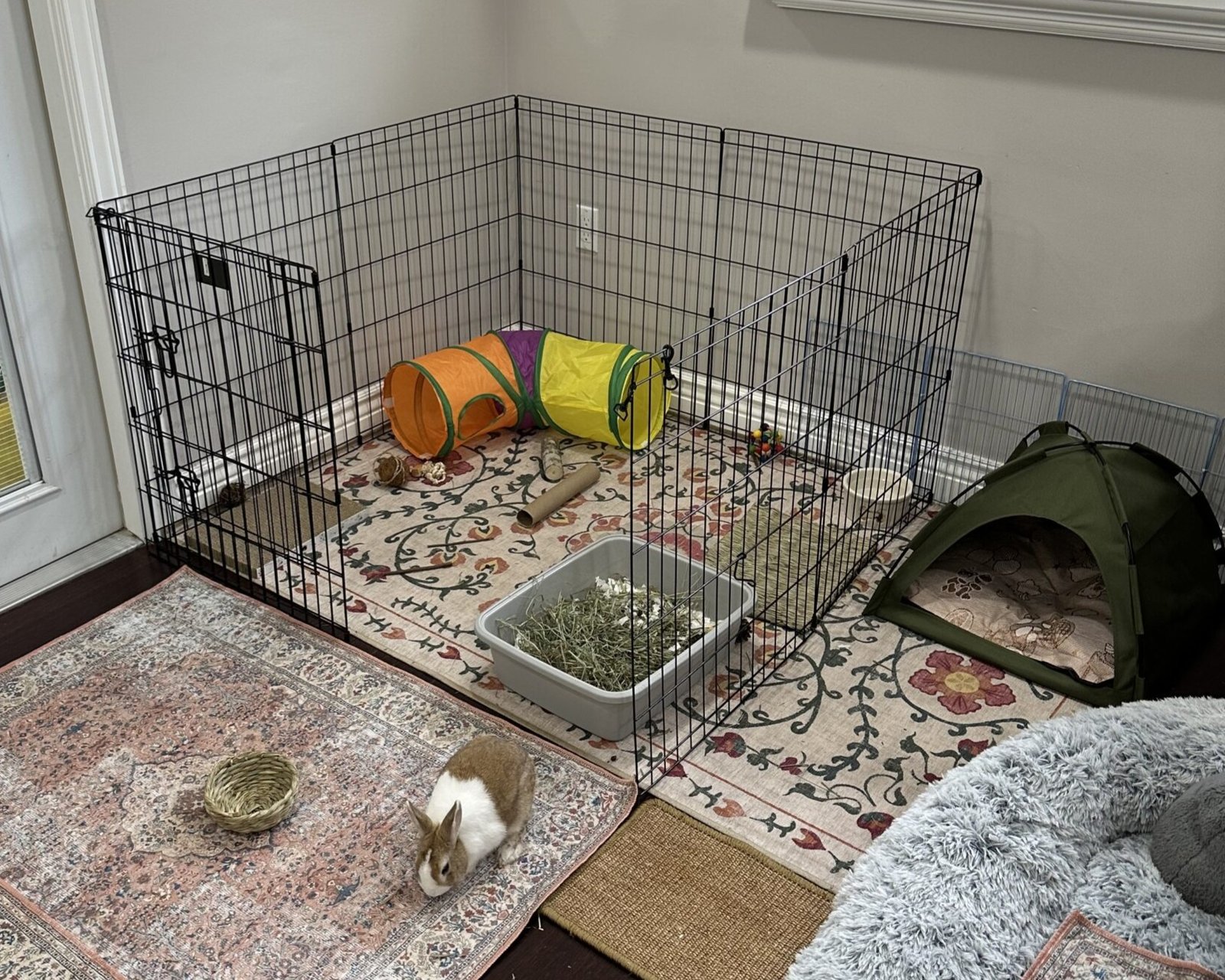
MINIMUM RABBITAT SIZE:
4 × 4 ft (16 sq ft) – 1 dwarf (2-4 lb)
4 × 6 ft (24 sq ft) – 1 medium (5-9 lb) or 2 dwarfs
6 × 6 ft (36 sq ft) – 1 large (10-14 lb) or 2 mediums or 3 dwarfs
FREE ROAM – giant breeds (15 lb+)
A single dwarf rabbit needs a minimum 4ft x 4ft (16sq ft) living space when enclosed, preferably 4ft x 6ft (24sq ft).
This will be their “home-base” for when you cannot supervise them. For each additional rabbit (or 4lb of body weight), add 8-12sq ft to their living space to maintain a healthy and harmonious environment and prevent fighting and bulling due to resource guarding amongst multiple rabbits. Giant breeds will need an entire room to free roam all of the time.
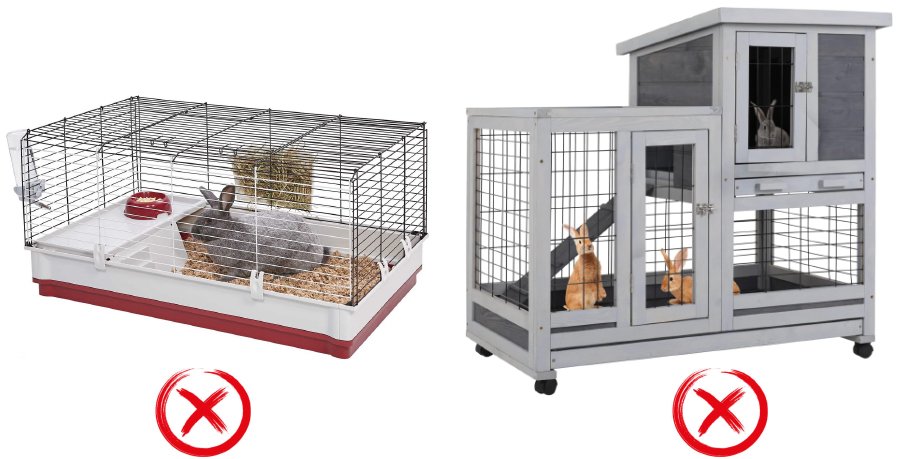
Cages and hutches DO NOT provide enough room for exercise and overall well-being for rabbits. Not providing enough space can lead to a host of problems due to depression and frustration. These often lead to rabbits pacing back and forth, cage chewing (which can damage their teeth), and cage aggression (growling, lunging and biting at hands that reach into their space or during cleaning). Health issues such as obesity, heart disease, muscle atrophy, skeletal changes, and infections are more common. Cages and hutches are also notoriously difficult to keep clean as rabbits end up using the entire space as a litter box.
1 | Habitat
Minimum 30-36 in tall, 4 × 4 ft (16 sq ft); preferred 4 × 6 ft (24 sq ft)
- Area Rug – min 5 × 7 ft
- Litter Box & Litter – min 14 × 18 in
- Ceramic Water Bowl – 3-5 cups
- Hidey House
2 | Diet
- Hay – Alfalfa (juveniles) or Timothy (adults), min 90 oz
- Pellets – Oxbow Adult / Young Adult
- Greens – Spring Mix
- Treats
3 | Toys, Enrichment & Grooming
- Grooming Supplies – nail clippers & brush/comb
- Enrichment – chew-toys, snuffle-mats, tunnels, puzzle-toys
4 | Carrier
Single dwarf (2-4 lb): 12 W × 18 L in
Single medium (5-10 lb) or pair: 15 W × 23 L in
Rabbits & Children
MYTH: Rabbits are easy, low-maintenance or good “starter” pets for small children.
TRUTH: Because they are prey animals, rabbits are startled by fast movements and loud noises and do not usually like to be picked up or cuddled. When frightened, a rabbit may bite or scratch. Dropped rabbits often suffer broken bones or paralysis.
The Truth About the Easter Bunny
80 % of bunnies purchased for Easter are abandoned a few months later. Most will not survive to be 1 year old.
Every year after Easter and Christmas thousands of rabbits are abandoned in shelters or “released in the wild”, where they will not survive. Domestic rabbits lack the instincts to find food, water and shelter; many are hit by cars, attacked by predators or succumb to illness within days. Misconceptions that rabbits are cheap, short-lived, low-maintenance or good “starter” pets for children drive this tragedy.
#NotJust4Easter
You can follow YouTubers Lennon the Bunny and Sincerely, Cinnabun to learn more about life with a free-roaming rabbit.
4 Questions to Ask Yourself Before Adopting a Rabbit
Are you getting a bunny for your child? Children quickly lose interest in pets they cannot pick up or cuddle. Are you prepared to take over daily care if they do?
Where do you see yourself in 10 years? Rabbits can live 10+ years. Will you still love and provide for them when they are elderly and need special care?
Do you travel often? Rabbits cannot be left alone for days. Boarding costs $25-40 / day and rabbit-savvy sitters are rare.
Are you willing to spend $300-$1,200 on veterinary care? Annual exotic-vet exams run $75-90; emergencies or surgery can exceed $1,200 in one day.
Top 10 Mistakes Rabbit Owners Make
Bonding Rabbits
Want a friend for your rabbit? We offer Speed-dating (one-hour introductions to 4-5 potential matches) and Pre-bonding (we do the early bonding work for you, $50 / day, rabbits ready to live together in 3-7 days).
Requirements: All rabbits must be spay / neutered and vet-checked within the last 3-6 months.
Bonding criteria:
- AGE: within 1-2 years of each other.
- SIZE: within 1-2 lb.
- GENDER: M/F easiest; other pairs depend on personality.
- NATURE: submissive + dominant pairs bond fastest.
Out-of-State Adoption
- AGE: 6 mo – 7 yr (no long-haired breeds May-Aug unless shaved).
- SPECIAL NEEDS: none (blind / medical rabbits excluded).
- HEALTH CERTIFICATE: $105 / rabbit (required by law).
- TRANSPORT: adopter arranges and pays all costs.
Allergies
There is no such thing as a “hypoallergenic” rabbit – all rabbits shed and have dander. Rex-type breeds shed less because they lack an under-coat. All rabbits molt twice a year in spring and fall.
Watch a grooming demo: YouTube